
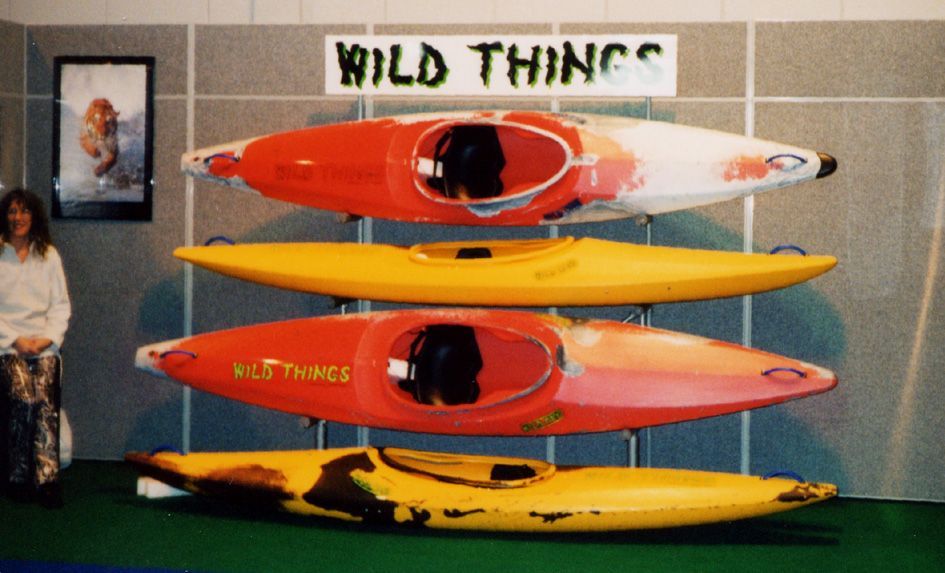
The Wild One is our superb all-round kayak which has
been designed for easy performance on all waters
With so many different kayak designs available today it seems the idea of a serious 'All-Round' kayak has been lost in the race to produce evermore specialist models. The 'Wild One' has been created to meet the undervalued requirement for a pure 'general purpose kayak'.
A purpose designed 'all-rounder'...fast redefining the term and establishing itself as the boat to have. Stable, fast and easy paddling on flatwater; yet responsive and predictable with superb performance in the rough stuff. True versatility for novice to advanced paddlers - the 'Wild One' excels as an all-rounder. It looks good, feels great and paddles superbly.
When the Wild One was designed and prototyped the aim was to produce a kayak that could be used in all commonly paddled waters by paddlers of widely differing size and abilities. The idea was to come up with a design that could be paddled miles along a canal one day; the next spent paddling whitewater grade 3 and the day after that covering long stretches of coastline in exposed conditions. The easiest mistake would have been to put too much emphasis on its whitewater performance and end up with another unexceptional (and so-called) "all-rounder" that was never designed or intended for serious use on flatwater or the sea. Instead, special attention was paid to the rocker - the curve along the keel from bow to stern and crucial to paddling speed. A unique asymmetric rocker was developed during prototyping and combined with a modified shallow arch hull. The blending of these hull lines give the "Wild One" a level of displacement paddling performance unique in this type of kayak.
The result is a stylish kayak that is comfortable, fast, agile, able and dependable in all water conditions.... a design without equal.
Flatwater Paddling speed and directional control not normally found in a canoe of this design and size due to its exceptional hull design. Cruises easily at 3 knots, with a fast touring speed of 4 knots. The ideal kayak for learning essential paddle skills and for progressing onto more adventurous water.
Whitewater Fantastic downriver paddling, rapid resurfacing, precise breakouts, good wave surfing and easy looping with predictable stopper handling; all you could want in an all-rounder. Sport spec is suitable for use on up to grade 3 whitewater (grade 4 with optional airbags).
Sea Paddle comfortably through chop and short seas with its vee-shaped bow and water shedding foredeck. The best 'sea-kayak' all-rounder by far. Space for day and emergency kit, perfect for rock hopping. Optional skeg extends the limiting wind envelope.
Surf The lifted bow, gentle centre rocker and hard rails at the stern combine for early planing down the line speed, fine control and fluid turns. Sport spec can be used in 4 - 6 ft surf.
Technical
buoyancy; closed cell black minicell buoyancy, 80N bow , 140N stern.
end grabs; semi rigid, tested to over 4000N. replaceable.
polyethylene; we use metallocene derived linear polyethylene, also known as superlinear. It is repairable and recyclable. Superlinear has excellent impact resistance for its rigidity.
Stainless fittings; all screws and nuts are highly corrosion resistant A4 grade stainless.
Dimensions
length 3.33m width 0.60m
volume 260 litres weight 17.5 kg
cockpit 78cm x 40cm inside
Design and how it affects performance,
Designed and manufactured to BSI 7852 (Code of Practice for design and construction of canoes)
Hull x-section; shallow arch with slight vee for optimum all-round use, stable enough on flatwater and forgiving in whitewater.
Planshape; widest point just forwards but almost symmetrical bow/stern.
Rocker; subtle through the centre of the hull and exaggerated towards the ends for easy flatwater paddling without compromising whitewater performance.
Bow; deep entry helps straight line tracking on flatwater, cuts cleanly into 'chop' and provides rapid resurfacing in whitewater. Rounded to minimise catching.
Gunwale; low and chamfered to give excellent edge control and lively performance.
Volume; well distributed, excellent reserve buoyancy.
Deck; carefully sloped away to the gunwale near the cockpit, this enables a good paddling stroke to be performed, something smaller paddlers find very difficult in many designs. High foredeck at cockpit front to resist folding. Shape of deck gives easy rolling, and avoids gunwale snatch.
Cockpit;
well placed seat and high front means all but the very tallest can lift knees out whilst seated. Rear of cockpit is low for easier rolling and it means kids aren't up to their armpits in canoe! Integral thighgrips fit just about anyone. Rim keeps decks on, undercut is reduced at the front for easy release.
Integral thighgrips; foam padded and fit just about anyone.
Seat; well contoured to fit all sizes closely and help with control, located a bit higher off the bottom than usual for better paddling (esp' kids), anti-slip texture.
Footrest custom moulded and fully contoured ergonomic fullplate footrest.
Fit & Comfort; intangibles, but extremely important, and always highly praised by users of all sizes.